
Rethinking how a technology council serves its members
Using mixed-methods research to redesign how nearly 1,000 member companies engage with the Council.
The 90-second version
Overview
During my two years at the Pittsburgh Technology Council (2024–2026), I led a research initiative into the member experience that ran from 2024 to 2025. The Council supports nearly 1,000 organizations, from startups to Fortune 500 companies, across technology, manufacturing, healthcare, education, and cybersecurity.
PTC already understood that members engaged with the organization in different ways. Staff brought deep knowledge of member companies and often tailored recommendations based on their experience, but there had been limited research to systematically capture and validate those patterns across the organization.
I led a mixed-methods research initiative to build a shared, evidence-based understanding of what members valued, how they engaged with PTC, and where opportunities existed to strengthen the experience. The findings helped identify retention opportunities and informed the Council's 2025–2028 strategic planning.
My role
I led research across qualitative, quantitative, and strategic workstreams, collaborating with internal partners where needed.
What members said, what the data showed, what leadership did with it.
Understanding member experience
I conducted 17 semi-structured interviews across eight industries to understand why members joined, what they valued, how they navigated PTC's services, and how their engagement changed over time.
From individual experiences to shared patterns
I synthesized interviews in two ways: across the member lifecycle to identify moments of friction, and across participants to identify recurring patterns in needs, behaviors, and service use.
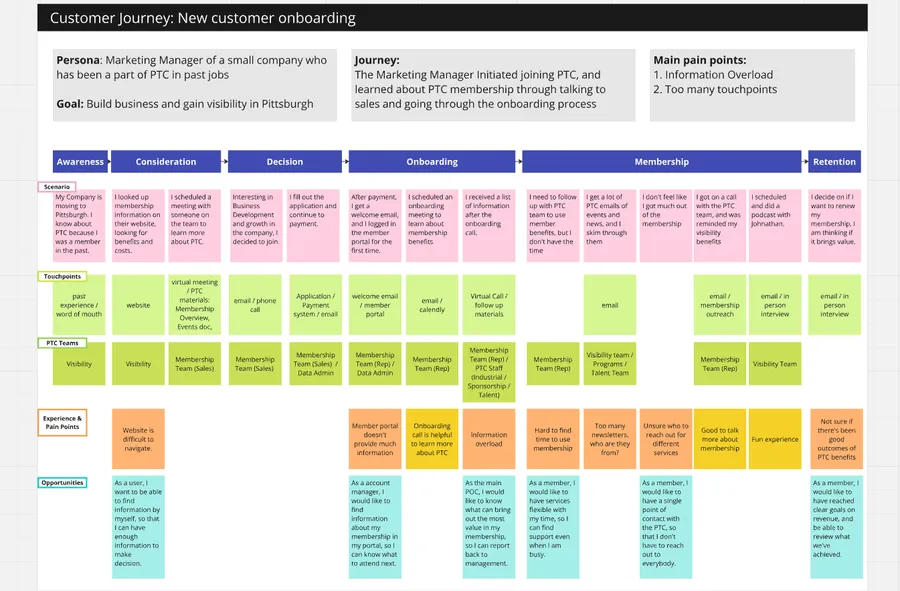
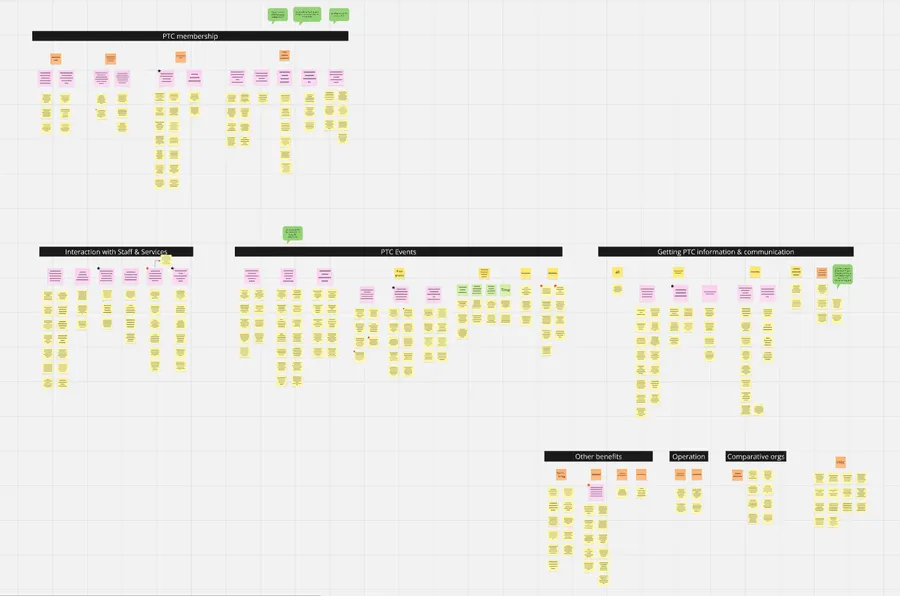
Key findings
An emerging pattern
Members weren't trying to use everything. They gravitated toward a small subset of services based on what their company was trying to accomplish.
This raised a larger question: Could we see these differences in actual service utilization across the broader membership?
Testing patterns against member behavior
Working with a data analyst who cleaned and prepared the CRM data, I analyzed member engagement and renewal patterns across broader industry clusters to test whether themes from the interviews appeared at scale.
Additional findings from data
Different industry clusters showed different relationships between service engagement and renewal, broadly reinforcing the qualitative finding that members found value in different parts of PTC.
Member tenure added another layer: the relationship between engagement and renewal looked different depending on how long a company had been a member.
Together, the qualitative and quantitative findings suggested that a single engagement model couldn't fully explain how members found value: both company context and membership stage mattered.
Turning research into strategy
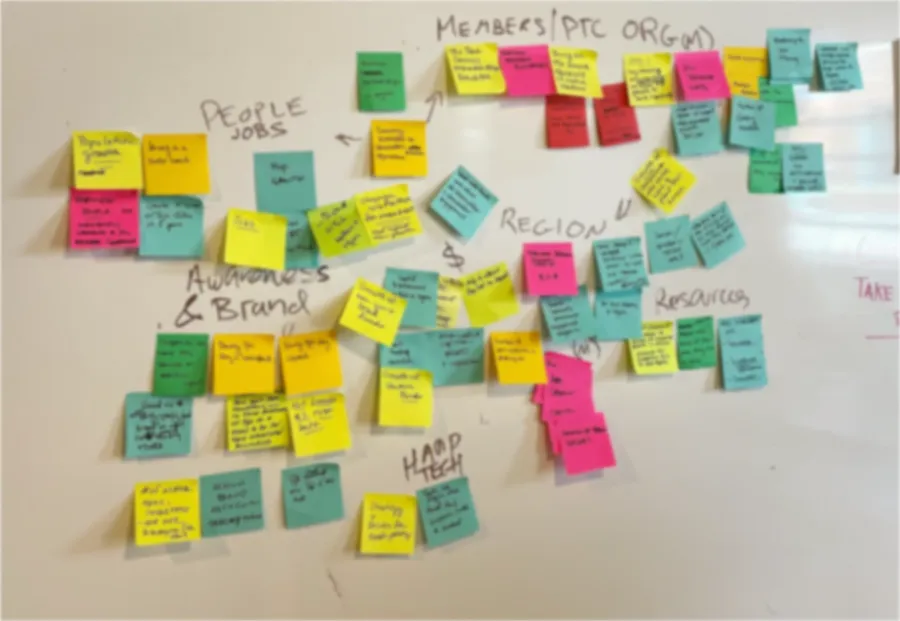
Research alone wasn't the goal. I facilitated strategic planning workshops with executives, staff, and board members to translate findings into organizational decisions and build alignment around shared priorities. These sessions moved stakeholders from discussing isolated services to thinking about the member experience as an integrated system.
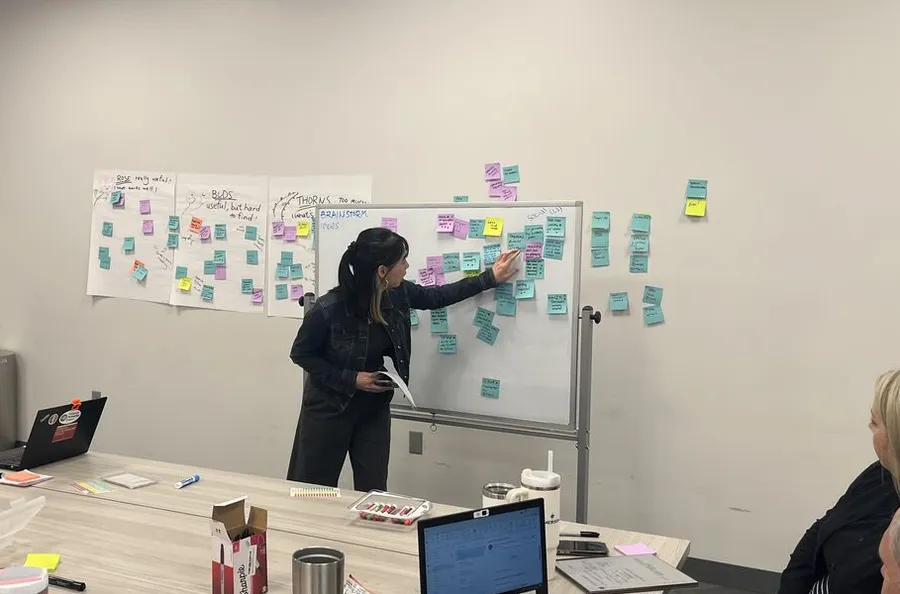
From insight to implementation
Unlike a typical product project, many opportunities required organizational change rather than interface redesign. PTC had deep institutional knowledge, but translating that knowledge into a shared approach meant navigating different member needs, existing workflows, and the realities of supporting nearly 1,000 companies.
The challenge wasn't simply identifying opportunities — it was turning research into recommendations teams could realistically adopt. That required understanding operational constraints, building stakeholder alignment, and connecting qualitative insight with quantitative evidence.
The work wasn't just about uncovering pain points. It was about making research usable within a complex organization.
Impact
The research provided evidence for a more targeted approach to member engagement. Findings around differing member needs and service use became one input into strategic planning, alongside leadership's organizational knowledge and priorities.
With leadership support, PTC moved toward a more coalition-based engagement model, expanding industry-focused communities such as Defense Robotics, Data Center, and Advanced Manufacturing.
Reflection
This project changed how I think about research impact. Strong findings matter, but they only go so far if they don't account for how an organization actually works. I learned to think beyond the research itself and consider what it would take for people to understand, trust, and act on it.
There's always more to the story.
Curious about the research, decisions, or what happened behind the scenes? I'd love to chat.